Internet Radio Licensing: Which Music Licenses You Need
An internet radio license is not one document. A station that streams commercial music needs two music licenses, one for the recordings and one for the songs, and a different body issues each in each country. This guide to internet radio licensing covers the United States, the United Kingdom and Canada: who to contact, what the starting fees were in 2026, and when a host that includes licensing is the simpler route. Figures were read from each body's own pages in November 2026. This is guidance, not legal advice.
Licensing covers the music. Your station still needs a voice between the songs. Make a station ID → JingleLark is an AI jingle maker that reads your station name in an on-air voice and mixes it with an intro, a music bed and an outro. Finished jingles are royalty-free to air, with no per-play fees.
What licenses does an internet radio station need?
An internet radio station that plays commercial music needs two licenses: one for the sound recording and one for the musical work. SoundExchange's Licensing 101 puts it this way: every recording embodies two copyrighted works, the composition (notes and lyrics) and the recording of it. A songwriter or publisher usually owns the first; a label or artist usually owns the second.
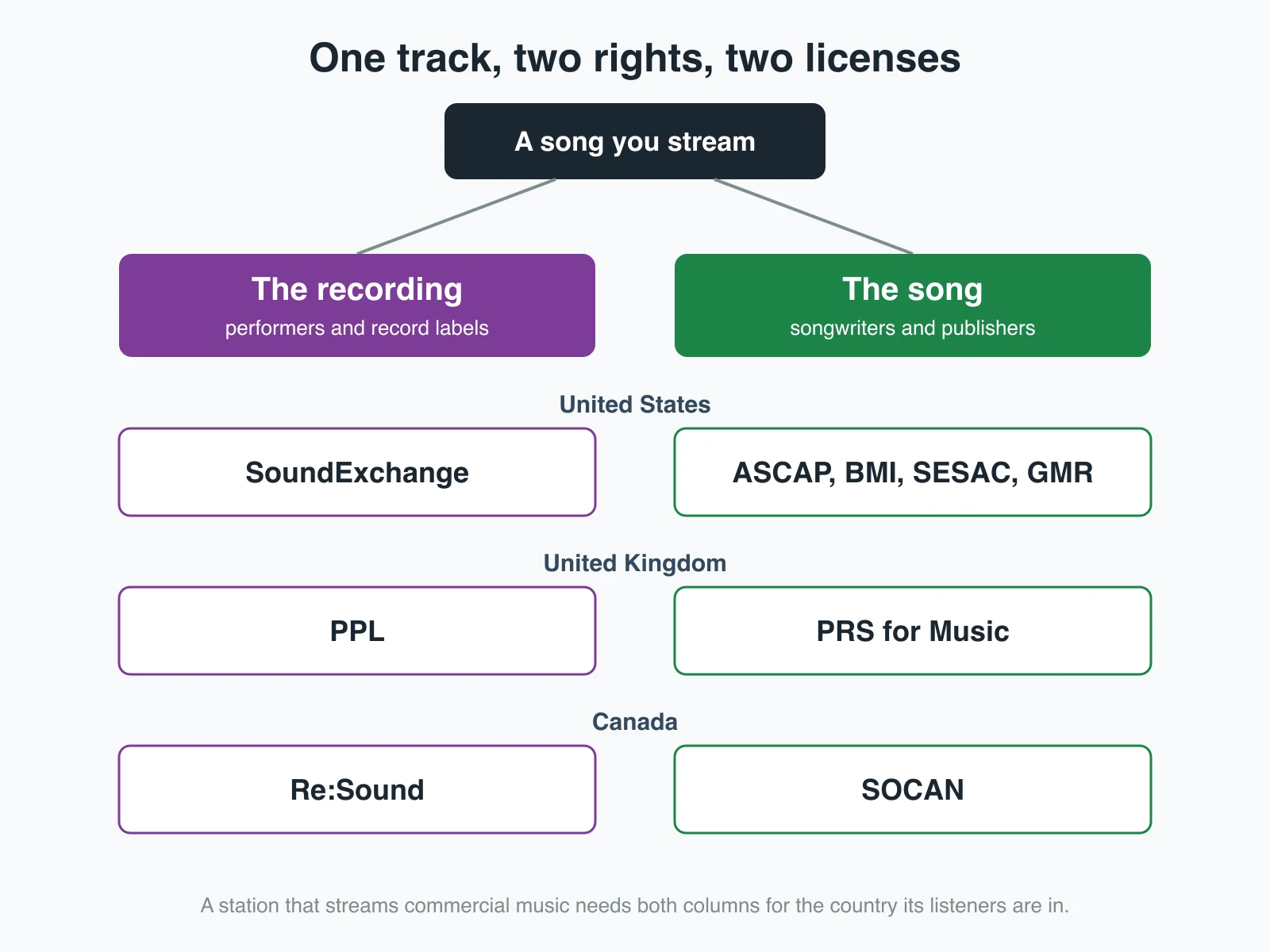
The bodies that license each right for online radio differ by country:
| Country | The recording | The song |
|---|---|---|
| United States | SoundExchange (statutory license) | ASCAP, BMI, SESAC, GMR |
| United Kingdom | PPL | PRS for Music |
| Canada | Re:Sound | SOCAN |
A music license is not a broadcast license. Ofcom says it does not regulate online-only radio services, so those stations need no Ofcom license, but they still need licenses from PPL and PRS for Music to play music.
Internet radio licensing in the United States
A US internet radio license comes in two parts: a statutory license for the recordings, and licenses from the performing rights organizations (PROs) for the songs.
The recordings: the statutory license and SoundExchange
The statutory license in sections 112 and 114 of the Copyright Act lets a noninteractive webcaster play commercial recordings without negotiating with each label. Noninteractive means listeners cannot pick the track or the artist. A station's main duties under it are:
- File a Notice of Use with the US Copyright Office before your first transmission. The filing fee is $50 on the 2026 fee schedule.
- Pay SoundExchange an annual minimum fee per channel.
- Send statements of account and reports of use. An internet-only commercial webcaster files both monthly and reports every track it plays.
- Keep to the sound recording performance complement, the license's cap on tracks per artist and per album. Our radio show ideas guide lists the numbers.
What you pay depends on the category your station falls into. The 2026 figures:
| Category | Who qualifies | 2026 minimum fee | Usage |
|---|---|---|---|
| Commercial webcaster | Internet-only stations not in the rows below | $1,000 per channel, credited against royalties | $0.0025 per performance (nonsubscription) |
| Noncommercial webcaster | Section 501 tax-exempt bodies and government entities | $1,000 per channel | First 159,140 aggregate tuning hours a month included, then $0.0025 per performance |
| Noncommercial educational webcaster | Noncommercial stations run or sanctioned by an accredited school or college and staffed mainly by its students | $800 per channel | Up to 160,000 aggregate tuning hours a month; stations under 80,000 can pay $100 more instead of filing reports of use |
A performance is one track streamed to one listener. First, timing: the commercial and noncommercial webcaster figures are 2025 rates carried over. SoundExchange's December 2025 memo says the Copyright Royalty Board had not yet published 2026–2030 rates for these categories, and that stations will owe a true-up payment or receive a credit once it does.
Second, "noncommercial" is a legal status, not a description of your income. Section 114 defines a noncommercial webcaster as one that is tax-exempt under section 501 of the Internal Revenue Code, has applied for that status in good faith, or is run by a government body. A hobby station run by one person with no revenue is a commercial webcaster under this definition.
The songs: ASCAP, BMI, SESAC and GMR
Each US performing rights organization licenses its own catalog, so a station that plays a wide mix of music deals with all four.
- ASCAP: an internet station that is not licensed by the FCC needs its New Media license, not a radio license. ASCAP's page for websites and apps says basic streaming fees depend on yearly sessions and revenue, and that its lowest tier is less than $1 per day.
- BMI: its digital music licenses start at a minimum of $350 per year (August 2026 archive copy).
- SESAC and Global Music Rights (GMR): contact each for a quote.
Internet radio licensing in the United Kingdom
In the UK, an internet radio license means two documents: one from PPL for the recordings and one from PRS for Music for the songs. Ofcom plays no part unless the station also broadcasts on AM, FM or DAB.
PPL's Linear Webcast Licence is priced in three bands per channel, per calendar year, excluding VAT. These are the 2026 fees:
| Band | Performances a year | 2026 fee |
|---|---|---|
| 1 | Up to 150,000 | £207 |
| 2 | 150,001 to 270,000 | £345 |
| 3 | 270,001 and up, or annual revenue over £5,000, or webcasting to several territories | £691 advance, recouped at £0.001380 per performance |
The license excludes stations funded by subscriptions or by a single sponsor. To estimate performances, multiply your listener hours by the number of tracks you play in an hour. Ten listeners for 8 hours a day at 12 tracks an hour comes to about 350,000 performances a year, which is already Band 3.
The PRS for Music Internet Radio Licence sets a £199 plus VAT annual minimum in its October 2026 commercial terms. Not-for-profit stations pay £199 for up to 800 listener hours a month and £398 for up to 1,658, then £0.02 per listener hour. Stations funded by advertising or sponsorship pay the greater of 10% of applicable revenue or £0.02 per listener hour. The PRS web page still showed a £193 starting fee when we read it, so confirm the figure when you apply.
PPL's hospital and student radio licenses cover hardwire, intranet and low-powered AM/FM services. PPL states that a hospital radio station or a student station that is online-only, or that simulcasts online, needs the Linear Webcast Licence. An Ofcom-licensed community station is different: its joint PPL and PRS license already covers UK internet simulcasts.
Internet radio licensing in Canada
A Canadian station pays SOCAN for the songs and Re:Sound for the recordings, under tariffs approved by the Copyright Board of Canada. Two tariffs for non-commercial stations carry published figures:
- SOCAN Tariff 1.B (2022–2027): a non-commercial AM, FM or internet-only station pays 1.9% of its gross operating costs for the year.
- Re:Sound Tariff 1.B: a non-commercial streaming service, meaning one owned and run by a not-for-profit organization, pays 36.50 Canadian dollars a year for its non-interactive and semi-interactive streams from 2026 to 2029.
Commercial online stations fall under other tariffs. Ask SOCAN and Re:Sound which one applies to your station before you launch.
Does a noncommercial station pay less?
A noncommercial station usually pays less, but no country in this guide lets it play commercial music for nothing. Each country draws the line differently:
| Country | Who counts as noncommercial | What changes |
|---|---|---|
| United States | Section 501 tax-exempt (or applied for it) or government-run (Section 114) | Monthly listening allowance inside the SoundExchange minimum fee |
| United Kingdom | PRS: a station serving "educational, cultural and community needs" that reinvests its revenue | Flat PRS bands by listener hours |
| Canada | Non-profit or not-for-profit, "whether or not" advertising funds part of its costs (SOCAN 1.B) | Percentage of costs for SOCAN, flat annual fee for Re:Sound |
Should you license it yourself or use a host that includes licensing?
License it yourself when you want full control and can handle the reporting; use a host that includes licensing when you would rather pay one monthly bill:
| License it yourself | Host that includes licensing | |
|---|---|---|
| Who holds the licenses | Your station | The host, for stations on its plans |
| Cost shape | Annual minimums per body, plus usage | A monthly plan with a listening-hour allowance |
| Reporting | You file statements and reports of use | The host reports for you |
| Territories | The ones you license | The ones the host has agreements for |
| Watch for | Missing one of the bodies | Coverage that ends when you leave the host |
Live365 is one host that bundles licensing. Its licensing coverage page lists SoundExchange, ASCAP, BMI, SESAC and GMR for the US, SOCAN and Re:Sound for Canada, plus Mexico, with the UK as a paid add-on. It also says coverage depends on accurate artist, title and album metadata for every track. Its Broadcast 1 plan was listed at $65 a month with 1,500 listening hours on Nov 21, 2026.
Not every host does. Radio.co's help center says the company "does not provide music licensing or coverage for royalties". Before you sign up with any host, find the page that names the licensing bodies and the countries. If there is none, you are licensing it yourself.
What do new stations get wrong about music licensing?
New stations most often assume that paying for music once, or earning nothing, settles the question. A licensing body or the law contradicts each of these five beliefs:
- "I bought the track, so I can stream it." A purchase gives you a copy. The right to perform a work publicly stays with the copyright owner under section 106 of the Copyright Act.
- "I have Spotify Premium." Spotify says its service is for personal, non-commercial use and that you cannot broadcast it from a business, and it names radio stations.
- "We make no money, so we don't pay." Every noncommercial rate above still costs something: a minimum fee, a flat fee or a share of costs.
- "Playing songs on a nonprofit station is fair use." Section 107 names four factors a court weighs case by case. Nonprofit purpose is part of one factor, not an exemption.
- "The license covers our podcast and listen-again shows." SoundExchange's 2026 noncommercial memo says the statutory license does not cover downloads, including podcasts of archived programming. In the UK, PRS allows listen-again for 30 days, while PPL's Linear Webcast Licence excludes on-demand content and downloads.
Can you run a station on royalty-free or Creative Commons music?
A station can run on music that sits outside the collecting societies, but each track carries its own terms. Creative Commons (CC) licenses are the most common case, and the license types differ in ways that matter on air:
- CC BY allows commercial use if you credit the creator.
- CC BY-NC allows noncommercial use only.
- All six CC licenses require attribution.
The Free Music Archive's FAQ answers the internet radio question directly: if advertising revenue is part of your project, you can only use CC music that allows commercial use, and most of it requires credit.
"Royalty-free" libraries need the same check. ASCAP's licensing FAQ says music that a provider has fully cleared for public performance may not require a license, then adds that "not all such services clear public performance rights".
Music licensed straight from an artist is the third route. Get the permission in writing, and make sure it covers both the recording and the song. Live365 takes the same line: its licensing does not apply to independent artists who are not registered with the bodies it lists, so you need the artist's written permission.
In what order should you get licensed?
Sort out licensing before the first public stream, in this order:
- List the countries your listeners are in. SoundExchange says transmissions that reach US listeners fall under US law wherever they start. Some hosts can block countries you hold no license for; Radio.co calls it geo-protection.
- Decide between a host that includes licensing and doing it yourself.
- If you do it yourself, start with the recording side (the Notice of Use in the US, PPL in the UK), then the song side.
- Log listener hours from day one. Most of the fees above are calculated from them.
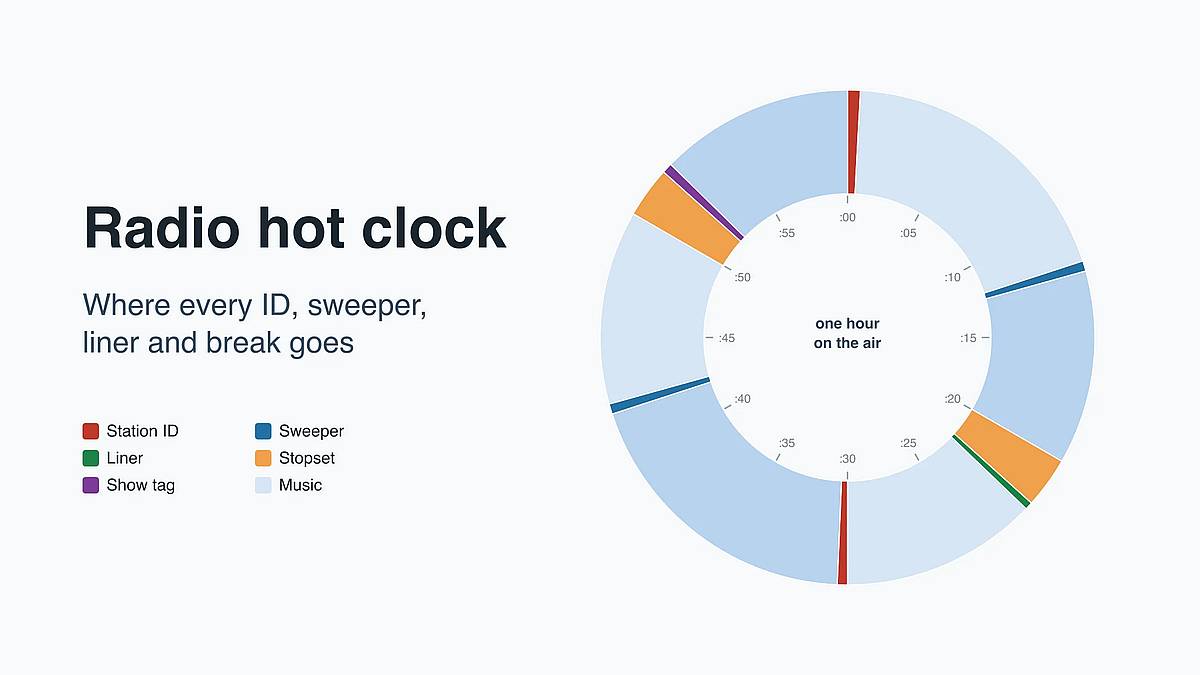
- Make your station IDs and build the hour around them with a hot clock.
The rest of the launch is in our guide on how to start an internet radio station, and jingles for internet radio covers the imaging a new stream needs.
Frequently asked questions
How much does an internet radio license cost?
An internet radio license costs $800 to $1,000 a year per channel for the recording side in the US at 2026 minimums, plus separate fees to each performing rights organization. In the UK, the smallest PPL band and the PRS minimum add up to £406 plus VAT a year at 2026 rates.
What happens if you stream music without a license?
Streaming without a license is copyright infringement, and in the US the owner can ask a court for statutory damages. Section 504 of the Copyright Act sets them at $750 to $30,000 per work, and up to $150,000 per work when the infringement is willful. The count is per work infringed, not per play.
Is it legal to run an internet radio station?
Running an internet radio station is legal. What keeps a music station legal is two music licenses, one for the recordings and one for the songs, or a catalog you have cleared track by track.
What is a blanket license for internet radio?
A blanket license lets a station play any work in one licensing body's repertory for an annual fee; ASCAP describes its own that way. No single blanket license covers a US internet station: each PRO licenses its own catalog, and SoundExchange handles the recordings.
Do station IDs and jingles need their own music license?
Station IDs and jingles are licensed by whoever made them, so check the terms that came with yours. Jingles you download from JingleLark are royalty-free for radio, podcasts, social media and paid ads, with no per-play fees and no expiry on the license. Jingles made with free credits are covered the same way.
Table of Contents
Author
Categories
Tags
More Posts
Radio Show Ideas: 14 Formats for Small Stations
14 radio show ideas for internet, community, hospital and student stations, the rule to check before each one airs, and how to lay an idea out as one hour.
Radio Hot Clock: A 60-Minute Template for Small Stations
A minute-by-minute hot clock for small and internet radio stations, the reason behind each slot, and how to set it up in PlayIt Live, mAirList, AzuraCast, Live365 or RadioDJ.