Radio Show Ideas: 14 Formats for Small Stations
A good radio show idea is one format, one angle that is yours, and three or four segments that come back every week. "Music and chat" is not an idea yet; "local bands, with one band in the studio each month" is. Below are 14 radio show ideas for small internet, community, hospital and student stations, each with the rule to check before it airs, then how to pick one and lay it out as an hour. These are ideas for scheduled radio shows, not podcasts.
Every show idea needs an opening. Make your radio show intro in an on-air voice. Make a show intro → JingleLark is an AI jingle maker that reads your show name and presenter name in a radio voice and mixes it with an intro, a music bed and an outro. The show itself, and its running order, stay yours.
What makes a good radio show idea?
A radio show idea is a format plus an angle, held together by recurring segments. Most idea lists mix up four different things, and pulling them apart makes planning easier:
| Term | What it is | Example |
|---|---|---|
| Format | The kind of show | A request show |
| Angle | What makes this one yours | Requests collected on the hospital wards that day |
| Segment | A recurring feature with a fixed slot | "Song of the week" at :30 |
| Topic | What one episode or one talk break is about | This weekend's street festival |
Recurring segments are what turn a pile of topics into a show. Farm Radio International, which trains rural broadcasters, tells producers to keep the run sheet consistent every week: the same signature tune, and the recurring segments in the same order, so listeners know what is coming next.
Radio also differs from a podcast in one way that shapes every idea on this page. Listeners join a radio show halfway through. Each segment has to make sense to someone who tuned in two minutes ago.
14 radio show ideas by format
The 14 ideas below are formats a small station can run with one or two presenters. Each row says what runs every week, which stations it suits, and what to check before it goes on air. Pick one, then give it an angle only your station can deliver.
Radio show ideas for small stations, by format:
| Show idea | What runs every week | Suits | Check before it airs |
|---|---|---|---|
| 1. Specialist music show | One genre, era or scene, with the story behind each record | Internet, community, student | US webcasts under the statutory license: limits per artist and album |
| 2. Request and dedication show | Listener requests and messages, played the same evening | Hospital, community | Hospital: ask your trust about ward visits |
| 3. Local magazine | Headlines, what's on, local sports, one interview, community notices | Community | Nothing special |
| 4. Guest interview hour | One local guest a week, such as a coach, a venue booker or a shop owner | Community, student | Nothing special |
| 5. Phone-in | One question per show, with callers on air | Community, talk | FCC-licensed stations: tell anyone you ring before airing the call |
| 6. Music quiz | Name the intro, name the year, local trivia | Any | FCC and Ofcom stations: publish the contest rules |
| 7. Listener-voted countdown | The week's top 10, voted by listeners | Internet, student | UK licensed stations: votes must be run fairly |
| 8. Themed hour | One theme a week: songs about weather, film songs, cover versions | Any | US statutory webcasts: no advance track list |
| 9. This day in music history | Releases, birthdays and anniversaries, with a local angle | Any | Nothing special |
| 10. New local music | Demos from local bands, one band in the studio each month | Community, student, internet | Nothing special |
| 11. Local history series | One story told over six to eight weeks, then a new series | Community | Nothing special |
| 12. Book and reading show | One book a month, short readings, a local author interview | Community, hospital | Nothing special |
| 13. Youth or student takeover | Students or young people run the hour, with a mentor | Community, student | Station approval of the show proposal |
| 14. Listener feedback show | What listeners liked and missed, read out and answered | Community | Nothing special |
Which radio show ideas need a rule check before they air?
The ideas above touch four rules that a small station can break without noticing: calls, prizes, music limits on webcasts and ward visits. Which rule applies depends on how your station broadcasts, so read only the lines that match yours. This is a pointer to the source, not legal advice.
- Phone-ins on FCC-licensed US stations. 47 CFR §73.1206 says a station must tell a caller before it records the call for air or puts it on live. Station staff, and callers who ring a show that usually airs calls, are presumed to know.
- Quizzes with prizes. An FCC-licensed station that broadcasts or advertises a contest it runs must disclose its material terms and run it as announced. Terms posted on the station website must stay up for at least 30 days after the contest ends. On UK licensed stations, Ofcom's Broadcasting Code says competitions and voting must be conducted fairly, with clear rules.
- Artist or album shows on US internet radio. Webcasters that use the statutory license, paid through SoundExchange, have to stay within the "sound recording performance complement" in 17 U.S.C. §114. In any three-hour period that means no more than three songs from one album (two in a row at most) and no more than four by one artist (three in a row at most). The same section bars publishing the specific songs in an advance schedule; announcing that an artist will be featured at some unspecified time is allowed. So "a whole album, track by track" does not fit that license; "one artist and the records that shaped them" does. What the statutory license costs and how to file for it are in our guide to internet radio licensing.
- Hospital request shows. At Radio Wey, a UK hospital station, volunteers who visit wards to collect requests need a DBS check and references carried out by the Hospital Trust. Ask your own trust before the first ward round.
Radio show ideas by station type
The same idea plays differently on different stations. Here is how the 14 formats above map to four kinds of small station.
Internet radio
An internet station competes with every other stream in its genre, so the radio show ideas that fit best are the specialist music show with a sharp angle (idea 1) and the themed hour (idea 8). Check the US license limits above before you plan an album or artist hour. In the UK, Ofcom does not regulate online-only radio, but music on an online station still needs licences from PPL and PRS for Music. Your web address can go into the show's spoken tags; our page on imaging for internet radio stations shows how to script it.
Community radio
Community radio is built on local voices. A 1994 UNESCO report written for Radio Sagarmatha, a community station in Nepal, recommends magazines, interviews, panels, quiz programmes and community bulletins as formats that give people a voice. That makes the local magazine (idea 3), the guest hour (idea 4) and the local history series (idea 11) natural fits. UK community stations also work to their Ofcom Key Commitments, which describe the programme service and how the community can take part. More on station sound for these stations: community radio jingles and IDs.
Hospital and student radio
Request shows are the backbone of hospital radio. In a member survey in the Hospital Broadcasting Association's 2016 impact report, 44% of responding stations played requests on all live shows, and most ran evening request shows with requests collected that day. The same survey found 76% broadcast interactive content such as competitions and on-air games, so a quiz (idea 6) is a good second show.
Some student stations ask for a plan first. The University of Hawaiʻi at Hilo's student station, for example, requires show proposals and talk show formats to be approved by a coordinator. For short student segments, RadioKing's list for school stations includes a weekly "Street Talk" vox pop of 2 to 4 minutes. Both kinds of station share one page on our site: hospital and student radio jingles.
How do you pick a radio show idea you can keep running?
Pick the idea you can still fill in week 12. Six questions sort a long list down to one:
- Can you write 12 episode titles today? If you stall at five, the angle is too narrow or too vague.
- Does it have a fixed shape? Same opening, same segments, same order, every week.
- Does it suit the slot? A late-evening hour suits requests or a reading show better than a quiz that needs callers.
- Who is it for? Name the listener: patients on a ward, students, fans of one genre.
- Can the people you have make it every week? One presenter can run a music, request or interview show. A phone-in usually needs a second person to take calls.
- Does any segment need a rule check? Calls, prizes, album hours and ward visits do (see above).
Then write the idea down as a one-page brief, starting with one line a listener could repeat. A community radio lesson plan from ABC's Behind the News lists what that brief should hold: show title, timeslot, presenters and producers, the main objective, and the features, segments and music you plan to use. A student station's coordinator will want the same page.
What segments can you add to a radio show?
A segment is a named feature that runs at the same minute every week. Radio show segment ideas that fit most of the formats above:
- Song of the week: one record and the story behind it.
- What's on: local events for the next seven days.
- Listener mail: two or three messages, read out and answered.
- Name the intro: one short clip, first correct answer wins.
- Would you rather: one question now, listener answers after the next song.
Give each segment a name and a short spoken tag, so listeners know it has started.
How do you turn a show idea into one hour?
Lay your show over the station's hour, not the other way round. The station's hot clock already fixes the station IDs and any breaks; your show fills the minutes between them with an opening, recurring segments and a close.
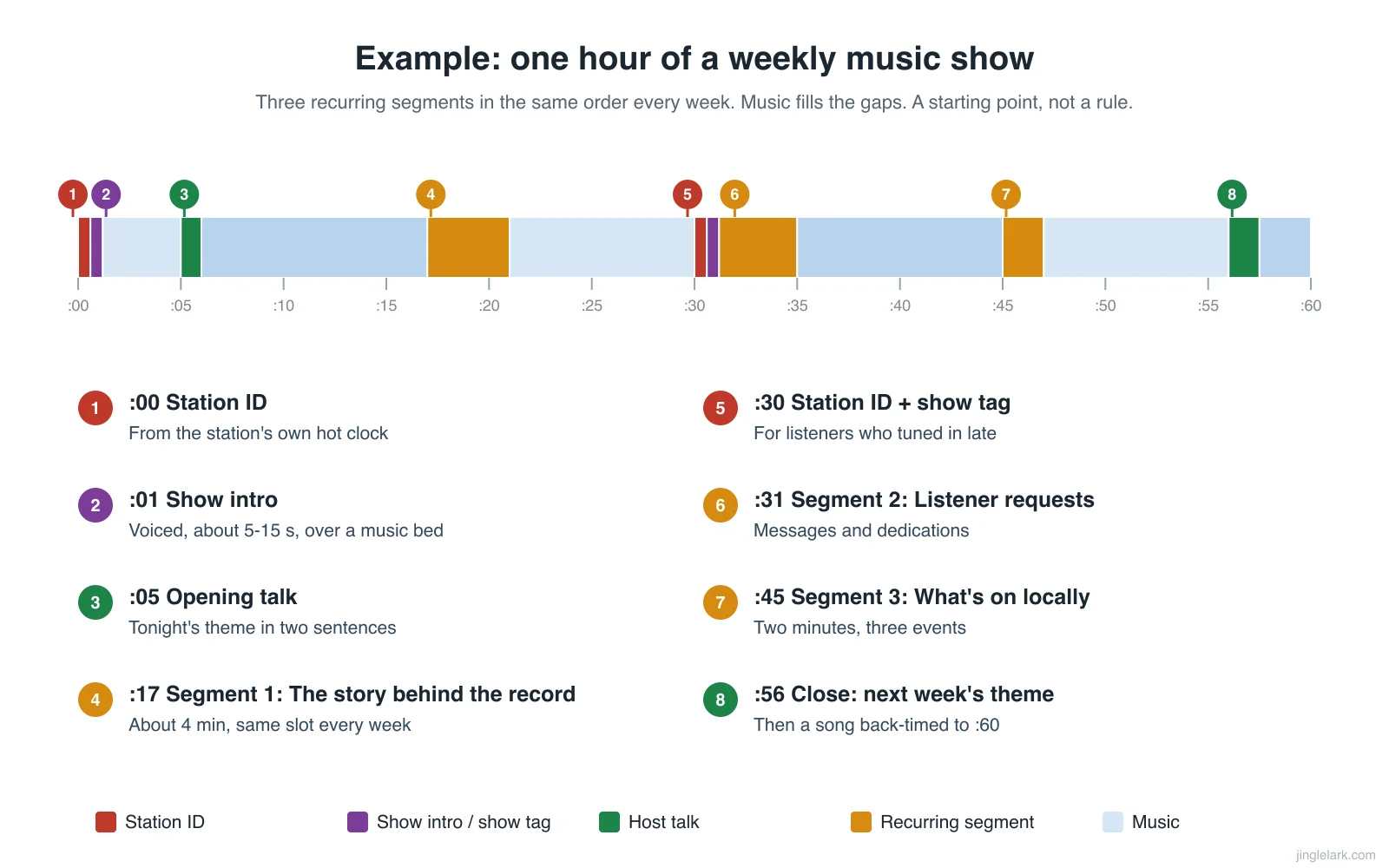
The example above is our sketch for a weekly specialist music show, not a rule. It follows the three-part shape Farm Radio teaches. The opening names the program and its main topic, the middle carries most of the content, and the end sums up and tells listeners about next week's episode. To write that hour out line by line, with the words for each talk break, see how to write a radio script.
- Opening: play the show intro straight after the station ID, then say what this week's show is about in two sentences.
- Middle: put each segment at the same minute every week. Elizabethtown College's student station manual suggests thinking of each hour as three 20-minute blocks, four 15-minute blocks or six 10-minute blocks.
- Half hour: repeat the show name for late arrivals with a show tag, a short voiced line that names the show or presenter. The radio imaging glossary has the difference between a show tag, a sweeper and a liner.
- Close: trail next week's theme, then back-time the last song so it ends on the hour.
What should you call your radio show?
Name the show after what it does or who presents it, so a listener can repeat it to a friend. Our radio station name generator has a section of radio show name ideas by format, and the radio slogans guide covers patterns that work for show names. Say the name out loud a few times before you commit: it goes into every show intro and tag.
Where do you find new topics every week?
New topics come from four places: the calendar, show prep services, your listeners and your own area.
- The calendar: holidays, anniversaries and local events give you a hook for most weeks. List them a month ahead.
- Show prep services: Radio Online, for example, sells daily show prep for air talent: a daily prep sheet, a show prep database and an almanac.
- Your listeners: the same UNESCO report on Radio Sagarmatha suggests designing a quiz as a built-in way to get listener feedback.
- Your own area: set a news alert for your town. What happened there on this date makes a better segment than a national "this day in history".
Frequently asked questions
What are some good themes for a radio show?
A good theme gives one episode a single thread that a listener can pick up halfway through. Themes that fill an hour include songs about weather, film songs, cover versions, one year in music, local bands and the holiday that week. Line up 12 weeks of themes before the first show airs.
What are some funny ideas for a radio show?
Funny ideas work best as short recurring bits inside a show. Try an "unpopular opinion" of the week, a "wrong answers only" quiz question, or the "would you rather" segment above. Keep each bit under five minutes.
How long should a radio show be?
One hour a week is the usual starting slot on student stations. The University of Hawaiʻi at Hilo's student station schedules music and talk shows as one hour a week, and Elizabethtown College's station requires one hour and encourages two. These are station policies, so check yours.
Can JingleLark make my radio show intro?
Yes. Type your show name and presenter name, pick an on-air voice, and JingleLark reads the line and mixes it with an intro, a music bed and an outro, ready to download as MP3 or WAV with no watermark. The same studio makes the short show tags you play at the half hour; see our DJ tag maker. It does not write the show or plan the running order. You get 1 free credit when you sign up, and paid packs start at $14.90 for 50 credits, with no subscription.
Table of Contents
Author

Categories
Tags
More Posts
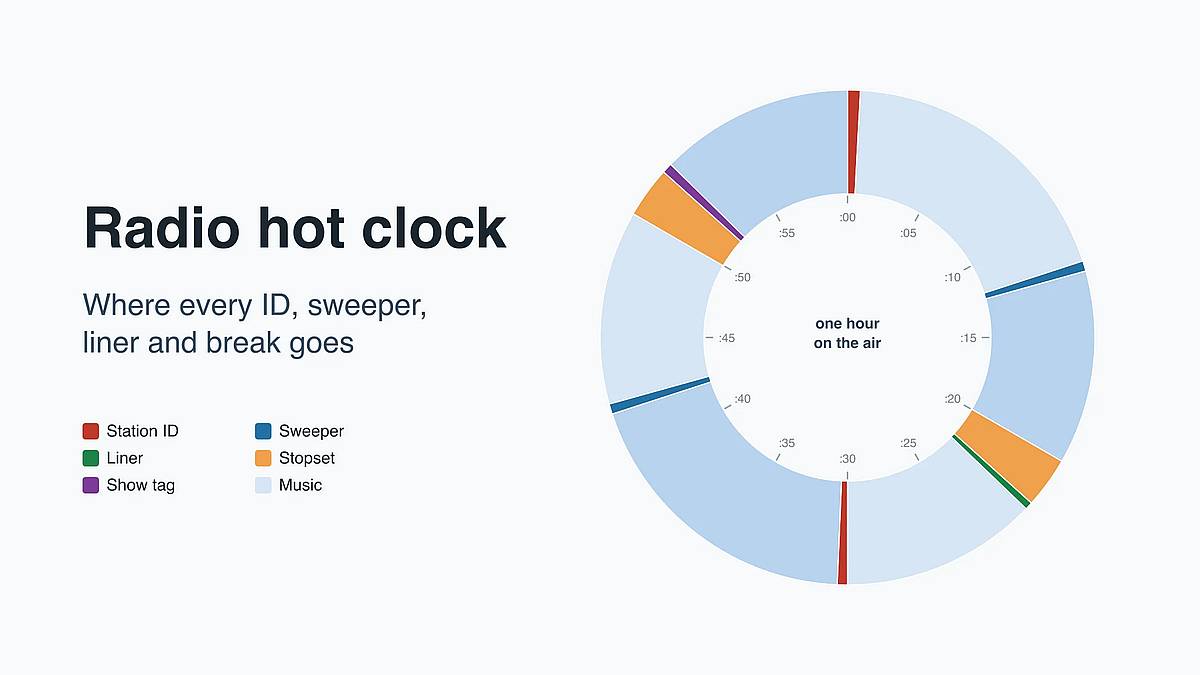
Radio Hot Clock: A 60-Minute Template for Small Stations
A minute-by-minute hot clock for small and internet radio stations, the reason behind each slot, and how to set it up in PlayIt Live, mAirList, AzuraCast, Live365 or RadioDJ.
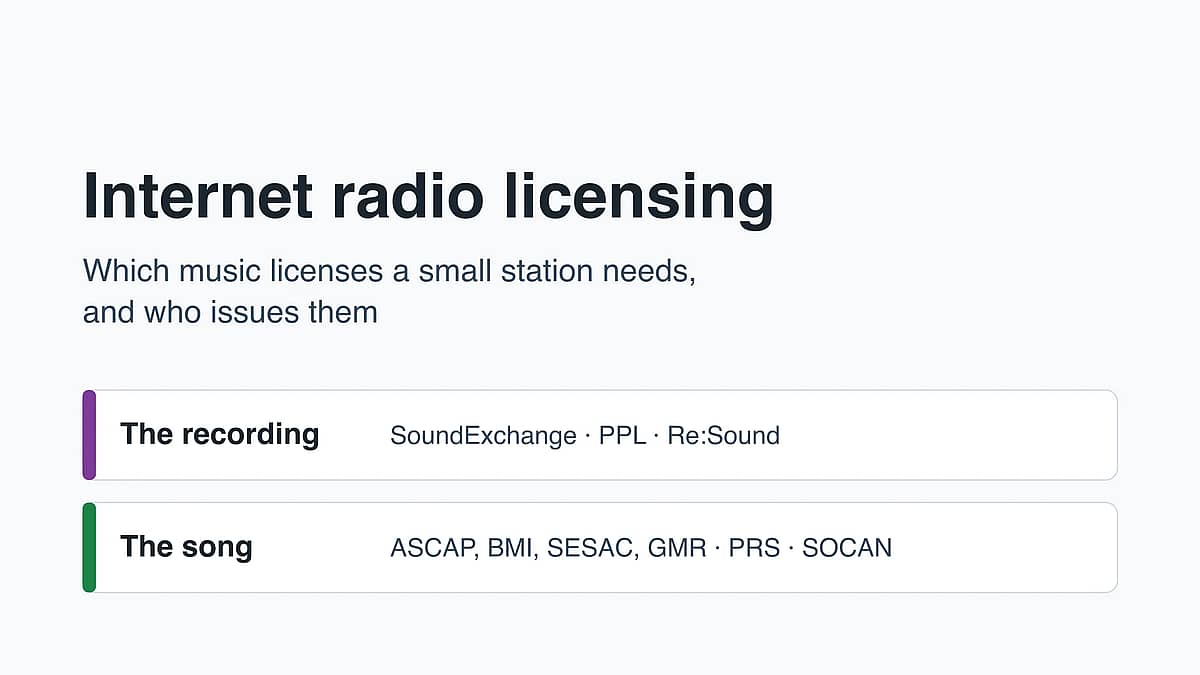
Internet Radio Licensing: Which Music Licenses You Need
Internet radio licensing for small stations: the two music rights, who licenses each in the US, UK and Canada, what stations pay, and when a bundled host fits.