Radio Formats: 9 Types, Rotation Clocks & Station Imaging
Radio formats are the programming blueprints that define what a station plays, how often tracks repeat, how presenters speak, and how station imaging sounds. Choosing one clear format helps internet, community, and hospital radio stations earn loyal listeners instead of blending into generic playlists.
Match your station's voice to your format in minutes. Try JingleLark's studio → JingleLark is an AI jingle maker that voices scripts in 36 radio voices and mixes them with intros, music beds, and outros into air-ready MP3 or WAV station IDs, sweepers, and show tags.
What Is a Radio Format (and How Is It Different from a Music Genre)?
A radio format is a station's complete programming design, combining its music or speech focus, rotation rules, station imaging, and presenter style. A music genre names only a style of song, such as rock or country. According to the University of Delaware's broadcast elements guide, radio formats coordinate music, news, announcements, promotions, jingles, and announcing styles into one recognizable sound.
Two stations can share one genre while running different radio formats. A Classic Rock station airing deep album cuts with dry voiced liners sounds nothing like an Active Rock station pairing current singles with fast sweepers. Programmers separate radio formats from genres, clocks, and technical formats:
- Radio format: The listener promise covering what the station plays, what it excludes, who it serves, and what mood it keeps.
- Music genre: A single musical style, often one ingredient inside broader radio formats.
- Format clock (hot clock): The repeatable 60-minute template placing song categories, breaks, and station IDs each hour.
- Delivery and audio file format: Transmission types (AM, FM, DAB, satellite, or internet streaming) describe how a signal travels, while file formats (MP3, WAV, or AAC) describe audio encoding rather than programming.
Small internet radio broadcasters often skip this boundary and run "a bit of everything" streams. Online, listeners browse directories by specific radio formats. A narrow, consistent format gives new listeners a one-sentence reason to return.
What Are the Main Types of Radio Formats?
Most commercial, community, and internet radio formats belong to nine core families, ranging from high-rotation chart pop to speech-led talk and locally driven community schedules. Each family sets a distinct mix of music eras, repeat speed, and voice style, which controls how much library upkeep and presenter time a station needs.
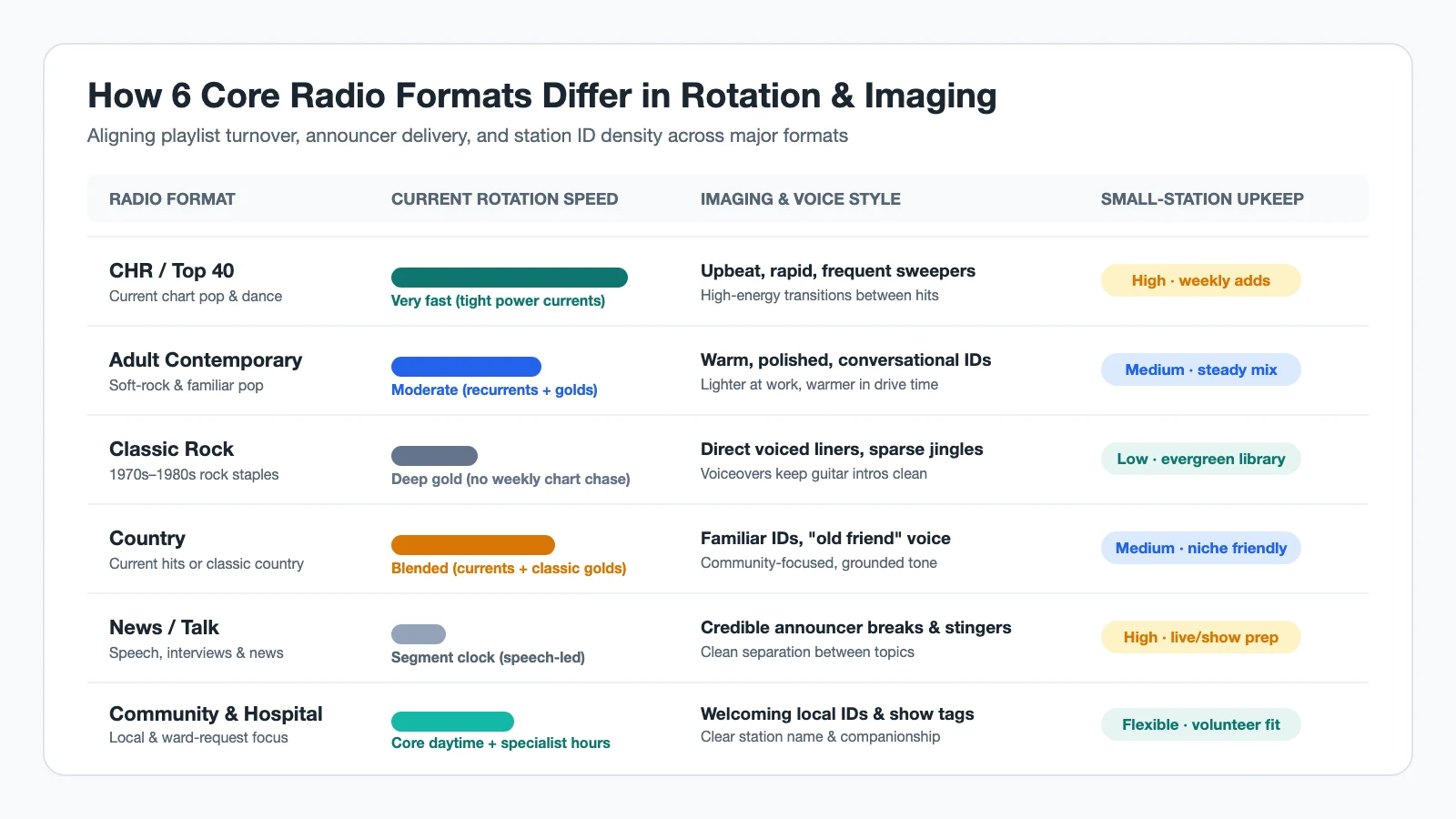
The table below summarizes nine established radio formats using definitions from Statistics Canada, the University of Delaware radio format grid, and UK Ofcom categories:
| Radio Format | Core Sound & Content | Typical Rotation Mix | Imaging & Voice Style | Small-Station Fit |
|---|---|---|---|---|
| Contemporary Hit Radio (CHR / Top 40) | Current chart hits (pop, rhythmic pop, dance); minimal talk | Tight currents, fast repeats, light recurrents | Upbeat, rapid announcing; punchy sweepers and frequent IDs | Demanding; weekly chart adds |
| Adult Contemporary (AC / Hot AC) | Soft-rock and pop aimed at adults (18–34 or 25–44) | Recurrents, golds, and selective currents | Warm, polished IDs; conversational delivery | Strong for daytime streams |
| Classic Hits & Oldies | Past chart hits, typically decades back (e.g., 1970s–1990s Classic Hits or earlier Oldies) | Deep gold library, no weekly chart chase | Familiar, upbeat retro-friendly IDs and liners | Very strong; low upkeep |
| Classic Rock & Active Rock | Classic rock staples (often 1970s–1980s) or modern plus classic rock | Deep gold rotation (Classic) or current plus gold | Sparser jingles; direct voiced liners and voiceovers | Strong for niche rock streams |
| Adult Album Alternative (AAA) & Alternative Rock | Modern alternative rock, indie, emerging artists, roots, and album cuts | Broad library, slower repeats, host-curated | Relaxed, understated IDs; space for song intros | Ideal for volunteer and college stations |
| Country | Current country hits, classic country, or Americana and bluegrass | Blended currents, recurrents, and classic golds | Friendly, "old friend" delivery; familiar IDs | Strong with a regional niche |
| Urban Contemporary (Hip-Hop / R&B) | Hip-hop, R&B, soul, and rhythmic hits (youth or Urban AC skew) | Fast currents or classic R&B and soul golds | Rhythmic, confident imaging with tight transitions | Strong for DJ-led streams |
| News/Talk & Sports | Local or topical news, interviews, call-ins, sports coverage | Spoken segments and timed breaks | Crisp, credible announcer IDs between segments | High presenter workload |
| Community, Hospital & Eclectic | Local music, ward requests, specialist shows, local speech | Core daytime format plus signposted specialist hours | Welcoming, local-identity IDs and show tags | Built for community and hospital radio |
Beyond these nine families, directories and ratings books also track major cultural and specialty radio formats, including Spanish-language and Latin (such as Regional Mexican and Tropical), Christian and Religious, Jazz and Classical, and dedicated Dance/Electronic streams.
How US and UK Radio Format Labels Differ
US and Canadian radio formats use standardized trade labels (CHR, Hot AC, AAA, Urban AC) built so ratings agencies could group stations for advertisers. In the UK, Ofcom does not lock music genres into legislation. Its framework separates mainstream popular music descriptions (Top 40, Current Hits, AC, Hot AC, Soft Pop, Adult Hits) from specialist descriptions (rock, rhythmic, classic/gold, dance, easy listening) and expects each licensed station to match its published service description.
Small internet radio stations do not need to copy a US trade code verbatim. Listeners only need to recognize your radio format from your directory listing, first three songs, and station IDs.
Which Radio Formats Have the Largest Audiences Today?
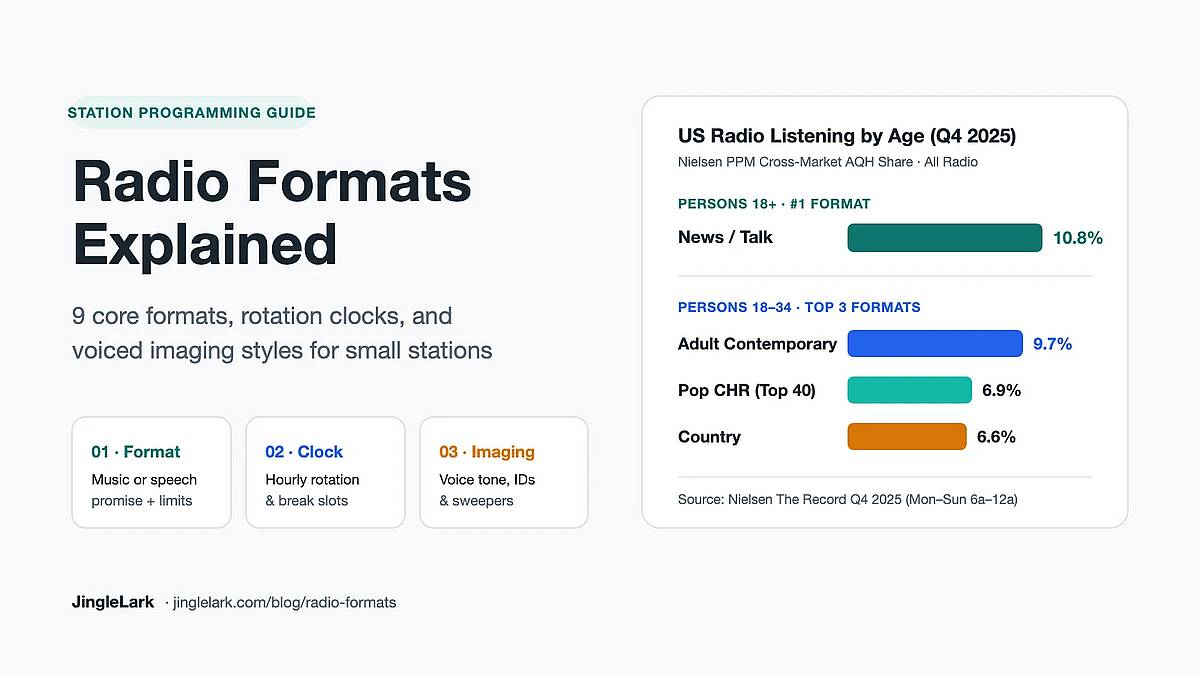
In the United States, News/Talk leads overall adult radio listening, while Adult Contemporary leads among adults aged 18–34. Because top radio formats shift sharply by age bracket, small station managers should never pick a format from one all-adults chart.
According to Nielsen's The Record Q4 2025 data tables (PPM Cross-Market AQH Share, Monday–Sunday, 6 a.m.–midnight, covering commercial and non-commercial over-the-air plus streaming listening):
- Persons 18+ (all radio): News/Talk ranked first at 10.8% of all radio listening.
- Persons 18–34 (all radio): Adult Contemporary ranked first at 9.7%, followed by Pop Contemporary Hit Radio (CHR) at 6.9% and Country at 6.6%.
Before using ratings tables, separate audience share from audience reach. Average Quarter-Hour (AQH) share reports a format's share of total listening time within a defined universe, not the percentage of people who tuned in. Nielsen also reports all radio separately from AM/FM streaming alone.
For an independent station, the largest national radio formats are the hardest places to compete head-on. Commercial networks run broad Top 40, Country, and News/Talk with full-time music directors. Small stations win by owning a focused slice (such as 1980s synth-pop, regional Americana, or ward requests) that big networks skip.
How Does Your Radio Format Shape Your Music Rotation and Hot Clock?
Different radio formats require different music rotation categories, and a hot clock turns those categories into a repeatable 60-minute schedule. Without rotation tiers, AutoDJ shuffles your library evenly and buries signature tracks behind obscure cuts.
The University of Delaware's broadcast readings outline five classic rotation tiers used across music radio formats:
- Power Cuts (Ultra rotation): Highest-priority current hits or signature tracks.
- Super Cuts (High rotation): Strong secondary current songs filling remaining slots.
- Recurrents (Moderate rotation): Recent hits that just left the top tier.
- Golds (Level rotation): Proven past hits listeners still recognize and request.
- Bronze (Light rotation): Novelty, regional, or special-interest tracks played sparingly.
Scheduling software and broadcast guides name these tiers slightly differently ("Power Cuts" vs. "A-list" or "Power Currents"), so focus on repeat speed rather than labels. For a tight current-hit format, AIIR's music scheduling guide gives an illustrative CHR setup of 10–15 A-list power currents, 20–30 B-list secondary currents, and 30–60 recurrent tracks. Classic Hits and Oldies radio formats drop current tiers and balance Power Golds against deeper Gold pools.
Once tracks sit in buckets, a format clock places them around the hour. TuneTracker Systems illustrates a mainstream music hour with 4 Power Currents, 3 Currents, 2 Recurrents, 2 Power Golds, and 1 Gold per hour. Treat published clocks as starting templates, adjusting counts for your library size and repeat tolerance.
To map songs, legal IDs, and sweepers minute by minute, use our radio hot clock template for small stations.
How Do You Match Radio Imaging and Voice Style to Your Format?
Every radio format sets listener expectations for voice tone, pacing, and how often station IDs appear between songs. Mismatched imaging, such as a loud nightclub hype voice on a soft Adult Contemporary stream, breaks listener trust faster than a bad segue.
The University of Delaware radio format grid documents how imaging habits differ across major commercial radio formats:
- CHR / Top 40: Frequent jingles and sweepers matched to current hits, paired with upbeat, rapid announcing.
- Adult Contemporary: Regular, polished IDs and warm delivery shifting from lighter workday liners to more personality in drive time.
- Classic Rock: Among the radio formats least likely to use jingles, favoring direct voiceovers and punchy voiced liners instead.
- Country: Familiar-sounding IDs and conversational hosts who sound like an old friend sharing the music.
- News/Talk and Sports: Crisp, credible announcer reads and brief stingers that separate spoken segments cleanly.
For hospital and community radio, warmth and local clarity matter more than high-energy hype. The Hospital Broadcasting Association (HBA) centers hospital radio on aiding patient recovery and wellbeing through ward requests, dedications, and friendly companionship.
Keeping one consistent station voice across every cut makes a small stream sound unified. Our radio imaging guide explains how station IDs, sweepers, and liners work together. In JingleLark, station managers cast from 36 radio voices across 9 on-air roles (including Radio & DJ, Hype & Announcer, British voices, Warm & Narrator, and Corporate & Clear) or clone their own voice from an 8–30 second sample. Because JingleLark produces voiced imaging rather than sung jingles, it fits spoken station IDs, sweepers, show tags, and DJ drops across rock, talk, AC, community, and internet radio formats.
How Should a Small Radio Station Choose (and Protect) Its Format?
Small radio stations should pick a radio format they can sustain 24 hours a day, confirm music licensing rules before launch, and enforce clear boundaries across live shows and overnight automation. Consistency beats chasing whichever format tops a national chart.
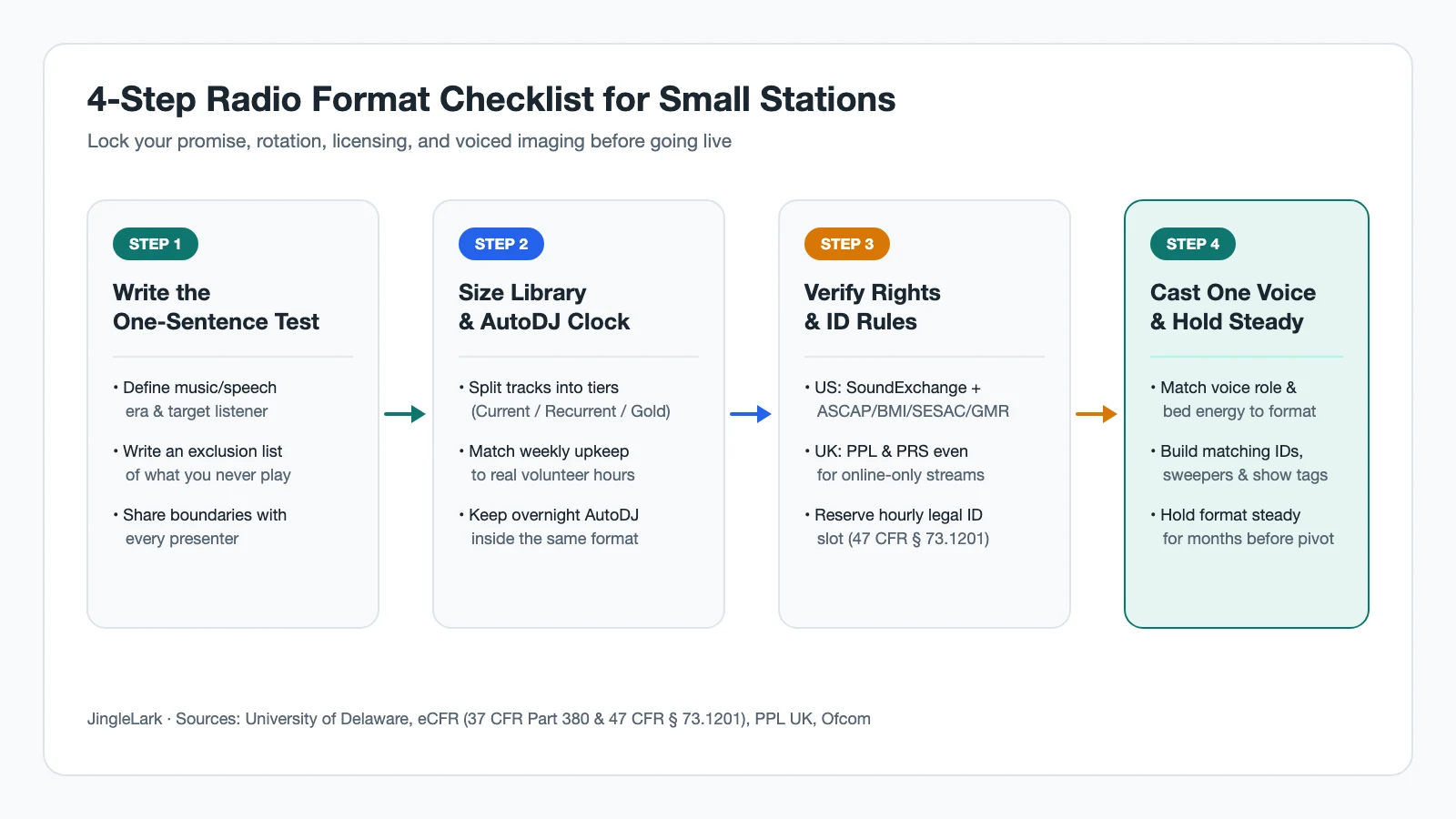
Follow four steps before locking your schedule:
- Pass the one-sentence test and write an exclusion list. State your format in one plain sentence a stranger would repeat: "Classic soul and Motown from 1965 to 1982, hosted from Manchester." Then list what you never play, such as current chart pop or explicit tracks. Clear exclusions protect radio formats better than long wish lists.
- Match the format to your library and presenter hours. Skip CHR if nobody can add new singles weekly. Confirm that overnight AutoDJ follows the same rules as live daytime shows, since automation fills most of a small station's week.
- Check music licensing and station ID rules before going live. Format choices carry legal rules:
- United States: Noninteractive internet streams playing commercial recordings need two separate clearances, as outlined by the U.S. Copyright Office: sound-recording rights under 17 U.S.C. §§ 114 and 112(e) (collected by SoundExchange) and musical-composition rights through PROs such as ASCAP, BMI, SESAC, and GMR. Under 37 CFR Part 380, the 2026 noncommercial webcaster statutory fee is $1,000 per year per channel covering up to 159,140 aggregate tuning hours (ATH) per month, then $0.0025 per performance above that cap. Licensed US broadcast stations must also air an hourly official call-letter and community-of-license ID under 47 CFR § 73.1201.
- United Kingdom: Online-only stations need no Ofcom broadcast licence, but recorded music still requires PPL and PRS for Music licences. Long-term UK hospital stations on low-power AM/FM or hardwired systems have a dedicated PPL Hospital Radio Licence alongside PRS for Music. UK analogue community stations must keep output aligned with their Ofcom Key Commitments. See our internet radio licensing guide for US, UK, and Canada rules.
- Hold the format steady before judging results. Listeners need weeks to learn what your station plays. Avoid drifting into random genres during slow weeks. If you switch radio formats, change cleanly, refresh your station IDs and sweepers together, and tell listeners why.
Frequently Asked Questions
Can an internet radio station mix two radio formats?
Yes, an internet radio station can blend closely related radio formats (such as Classic Rock and Blues, or Indie and Alternative) when the mood stays predictable. For a very different style like Jazz or Talk on a Pop stream, schedule it as a signposted weekly specialist show rather than mixing unrelated genres inside one daytime hour.
How many songs do you need to launch a music radio format?
The minimum library size depends on your format's repeat tolerance rather than one fixed number. A tight CHR station can start with roughly 10–15 power currents, 20–30 secondary currents, and 30–60 recurrents (per AIIR's scheduling example), while Classic Hits or AAA stations usually need several hundred songs so workday listeners do not hear gold tracks twice.
What is the difference between a radio format and a radio show format?
A radio format defines the entire station's 24-hour identity, including its music mix, audience, tone, and imaging rules. A radio show format defines one program's structure, such as an interview show, Top 10 countdown, or request hour. Multiple show formats can run inside one station format if they respect its boundaries.
When should a small station change its radio format?
Change radio formats only when your team cannot sustain the music or speech workload, or when months of consistent scheduling fail to attract your target listeners. Avoid tweaking radio formats every few weeks; when you pivot, update your hot clock, directory tags, and station IDs together.
Can you use an AI jingle maker for any radio format?
You can use an AI jingle maker for any radio format using voiced station IDs, sweepers, liners, show tags, or DJ drops, including CHR, AC, Classic Rock, Country, Urban, News/Talk, and community radio. JingleLark creates voiced jingles rather than sung jingles, mixes scripts up to 900 characters (~70 seconds) with 88 intros, beds, and outros at no extra charge, and exports royalty-free MP3 or WAV files. Signup includes 1 free credit that never expires, plus 1 check-in credit per 7-day streak (expiring after 30 days), and one-time packs start at $14.90 for 50 credits with no subscription.
Table of Contents
Author

Categories
Tags
More Posts
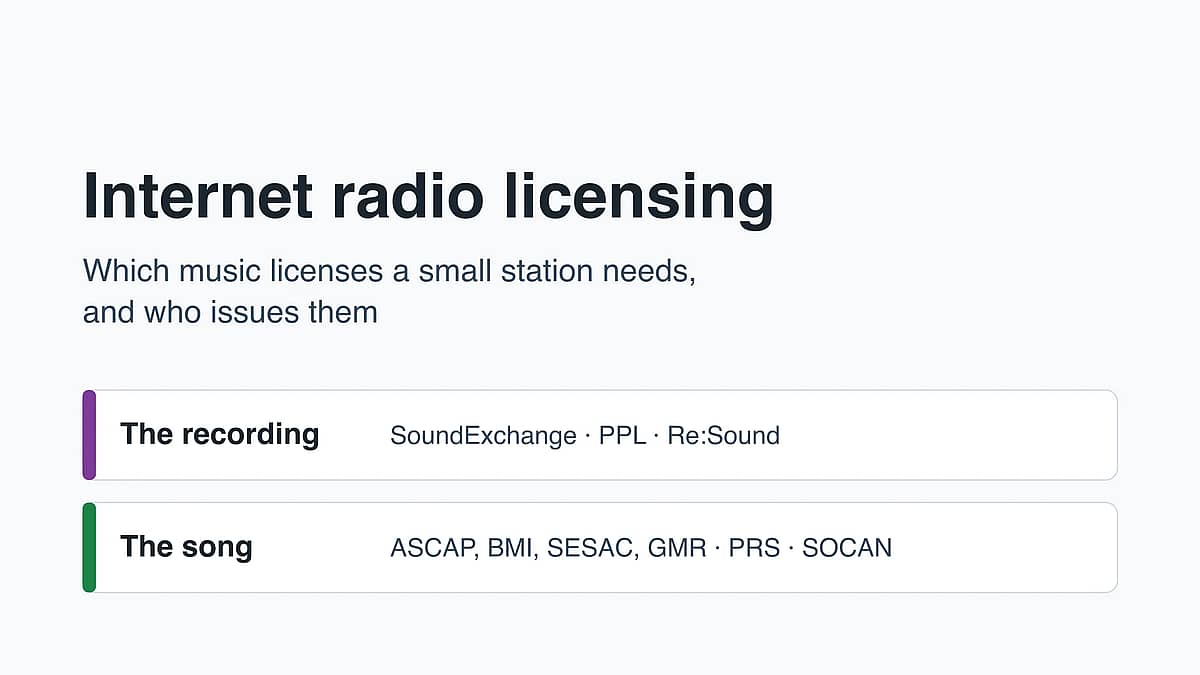
Internet Radio Licensing: Which Music Licenses You Need
Internet radio licensing for small stations: the two music rights, who licenses each in the US, UK and Canada, what stations pay, and when a bundled host fits.
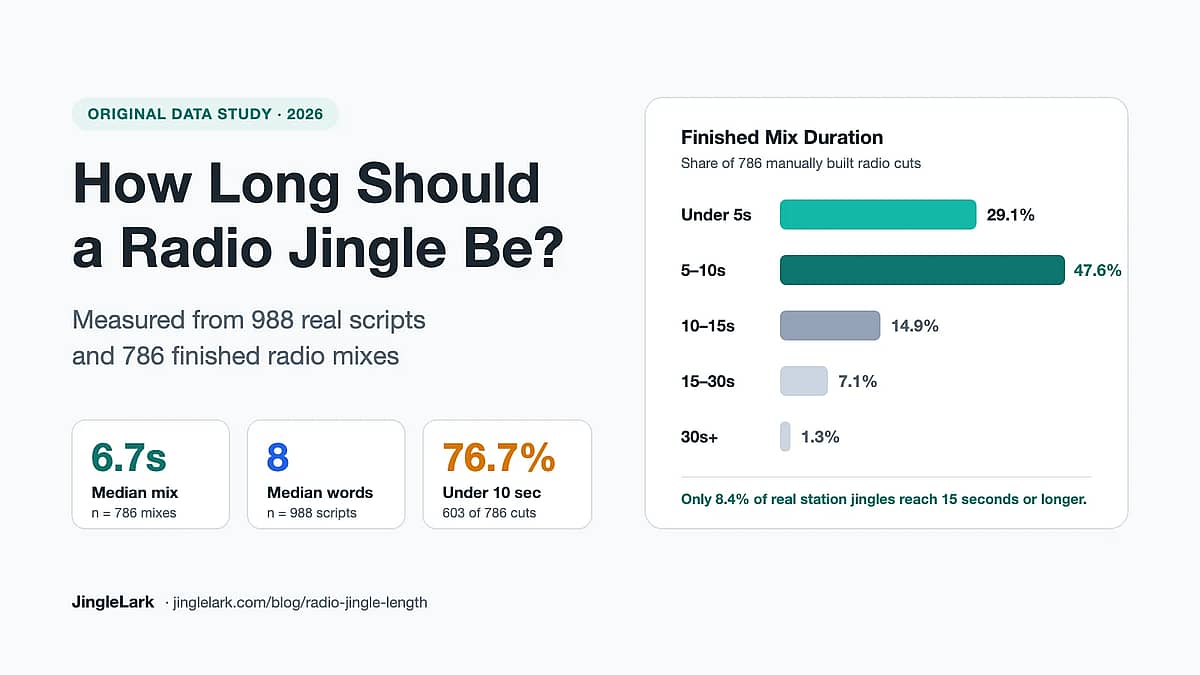
How Long Should a Radio Jingle Be? Data from 988 Real Scripts and 786 Mixes
Most radio imaging jingles run 5 to 10 seconds, not 15 to 30. Our analysis of 988 real scripts and 786 mixes breaks down length, word counts, and mixing choices for station IDs, sweepers, show intros and DJ drops.
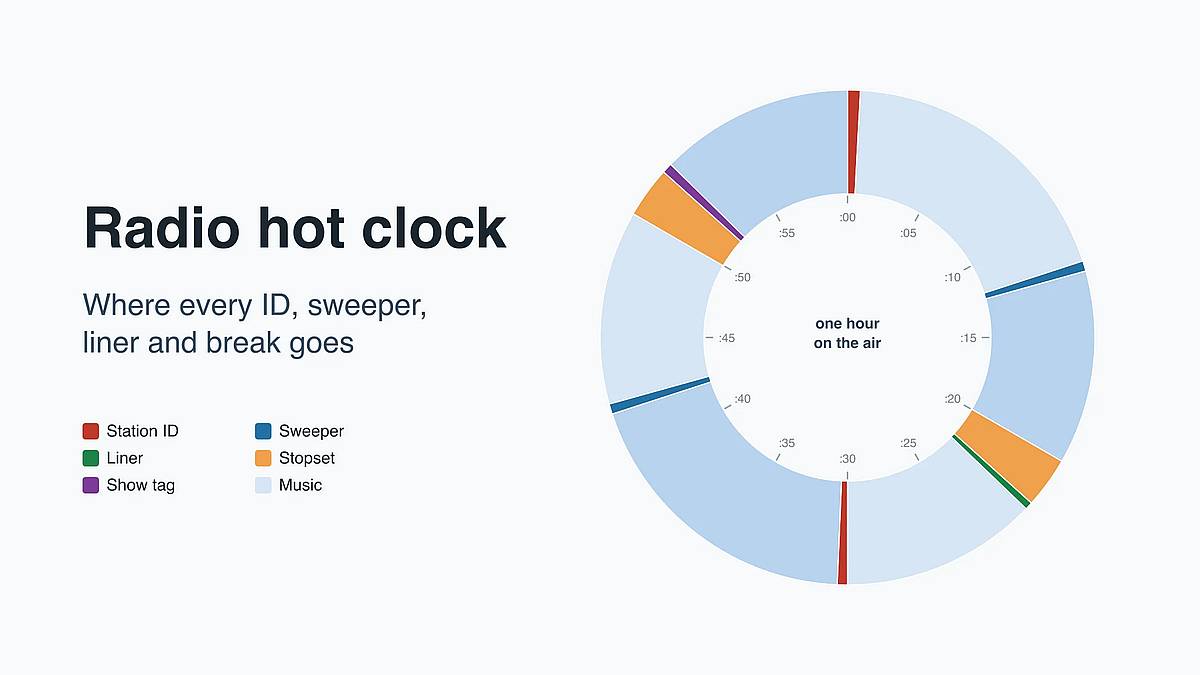
Radio Hot Clock: A 60-Minute Template for Small Stations
A minute-by-minute hot clock for small and internet radio stations, the reason behind each slot, and how to set it up in PlayIt Live, mAirList, AzuraCast, Live365 or RadioDJ.