How Long Should a Radio Jingle Be? Data from 988 Real Scripts and 786 Mixes
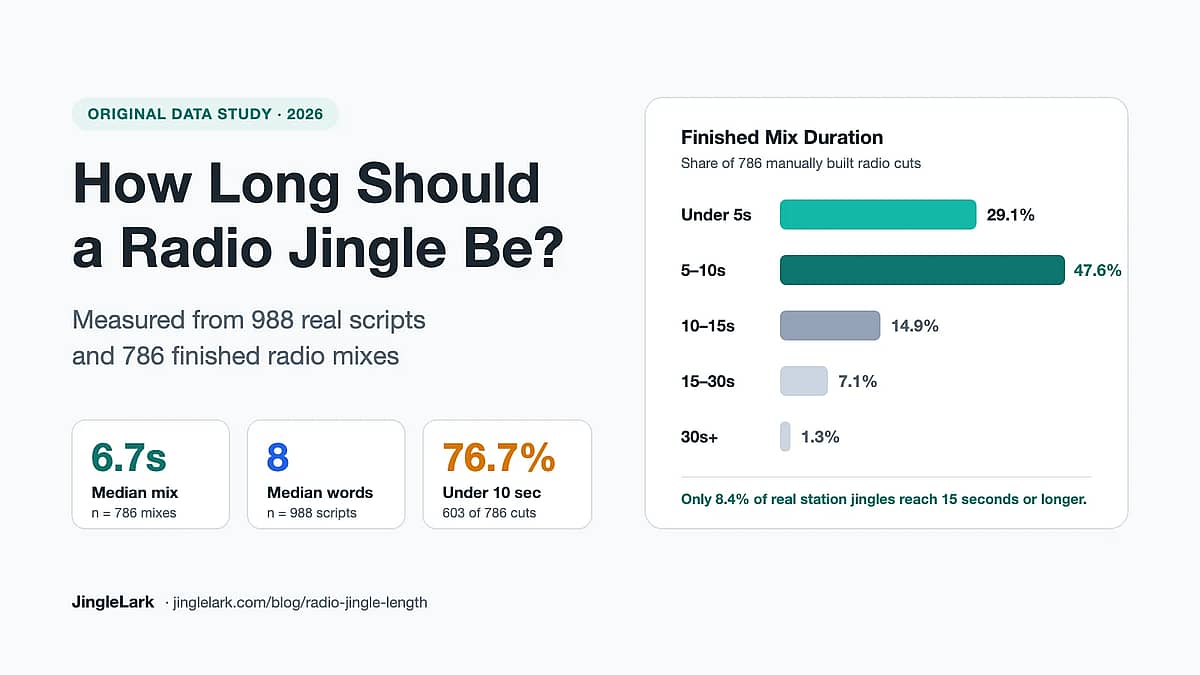
The ideal radio jingle length for station imaging is 5 to 10 seconds, not the 15 to 30 seconds quoted in advertising blogs. If you are deciding how long a radio jingle should be, our late-2026 analysis of 786 manually mixed radio cuts and 988 clean scripts found that 76.7% finished under 10 seconds, with a median runtime of 6.7 seconds and a median script length of 8 words.
Need a station ID or DJ drop that fits a 5- to 10-second slot? Make a station ID → JingleLark is an AI jingle maker that voices your script and mixes it with an intro, music bed and outro as MP3 or WAV, with free unlimited remixing.
How long is a typical radio jingle? (Data from 786 real mixes)
A typical spoken radio imaging jingle runs 6.7 seconds from the first sound effect to the final tail. When small internet, community and hospital stations build cuts for their own streams, half of all finished mixes land between 4.6 and 9.7 seconds (the 25th to 75th percentile).
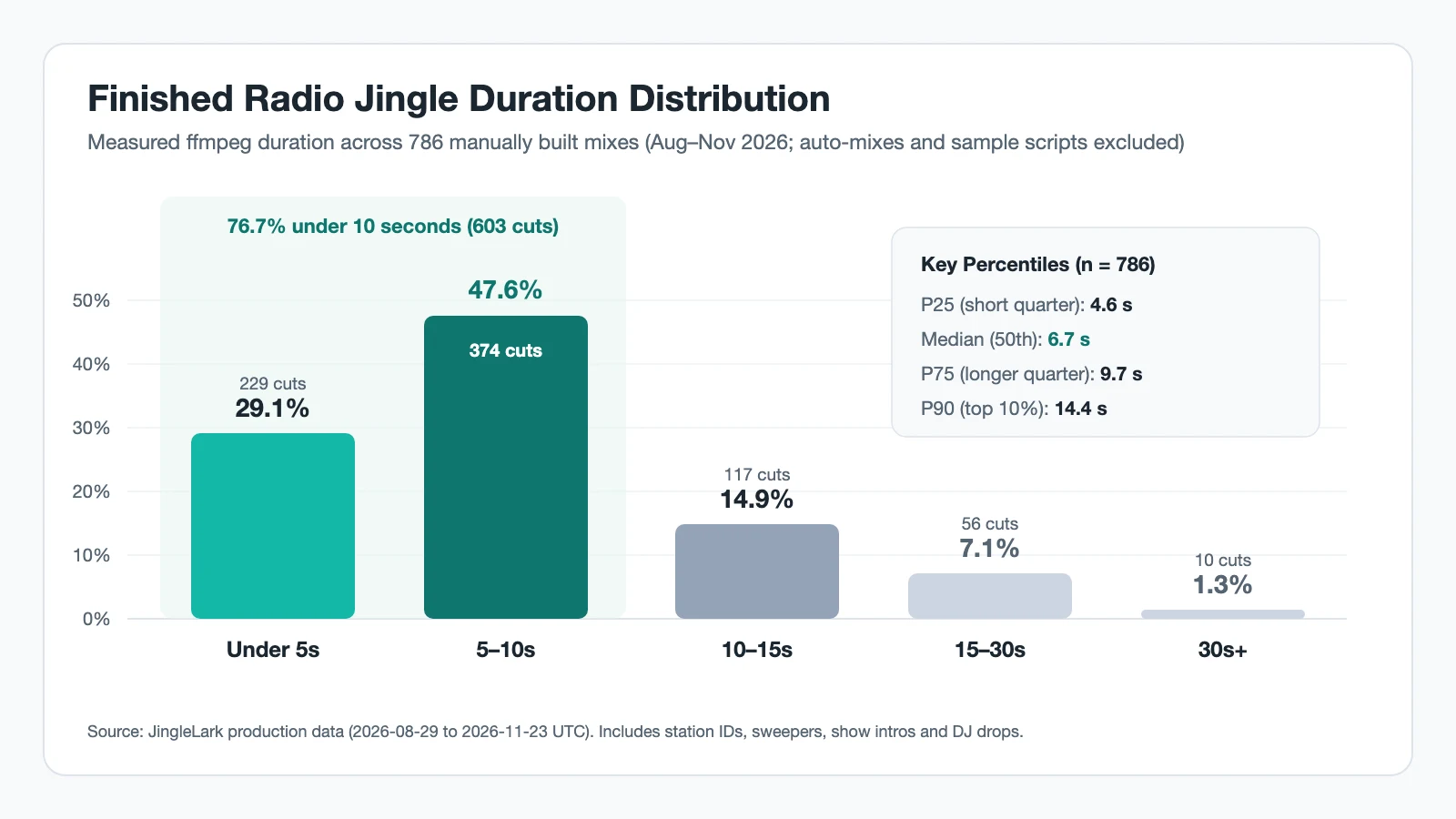
The table below shows the measured ffmpeg duration distribution across all 786 manually built mixes (excluding automatic starter mixes and verbatim sample scripts):
| Finished duration | Mixes (n = 786) | Share | Typical on-air use |
|---|---|---|---|
| Under 5 seconds | 229 | 29.1% | Fast DJ drops, stingers, sonic logos, short call-letter IDs |
| 5–10 seconds | 374 | 47.6% | Full station IDs, branded sweepers, presenter tags |
| 10–15 seconds | 117 | 14.9% | Multi-line show intros, promo liners with a bed |
| 15–30 seconds | 56 | 7.1% | Short sponsor reads, event promos, underwriting |
| 30 seconds or longer | 10 | 1.3% | Full 30-second sponsor spots or long show opens |
Why do so many articles claim a radio jingle should be 15 to 30 seconds? Those guides describe commercial advertising jingles (sung brand ads bought inside a stopset) rather than radio station imaging. Only 8.4% of real station cuts (66 of 786) reach 15 seconds, and just 1.3% (10 of 786) pass 30 seconds. Between two songs, a 20-second station ID feels like an interruption; a 7-second cut resets the listener's ear and gets back to the music.
How many words should a radio jingle script be?
Write 6 to 15 words (roughly 30 to 80 characters) for a standard station ID, sweeper or show tag. Across 988 real, non-sample scripts, the median length is 8 words (43 characters), and 59.7% of all scripts stop at 10 words or fewer.
The full word-count breakdown across 988 clean scripts shows how tightly real broadcasters edit their imaging lines:
| Script length (words) | Scripts (n = 988) | Share | Estimated dry voiceover | Typical mixed runtime |
|---|---|---|---|---|
| 1–5 words | 356 | 36.0% | 1–2.5 s | 3.5–5.5 s |
| 6–10 words | 234 | 23.7% | 2.5–4.5 s | 5–8 s |
| 11–20 words | 245 | 24.8% | 4.5–8.5 s | 7–12 s |
| 21–40 words | 125 | 12.7% | 8.5–16 s | 11–20 s |
| 41+ words | 28 | 2.8% | 16 s+ | 20 s+ |
In English radio delivery, a normal announcer voice reads at roughly 13 characters per second once punctuation and natural breath pauses are counted, which is slower than raw word-per-minute calculators assume. Intro risers and outro fades then add about 2 to 3 seconds around the voiceover. That is why an 8-word line (about 3.5 seconds dry) turns into a 6.7-second finished cut.
If you are drafting from scratch, our library of station ID and radio jingle scripts lists character counts alongside each template, and our radio script writing guide covers pacing for longer live links.
How does length change between DJ drops, station IDs and show intros?
DJ drops are the shortest cuts on the clock, while station IDs and show intros carry nearly twice the script length. Even so, all three imaging formats stay under 7.5 seconds at the median once mixed.
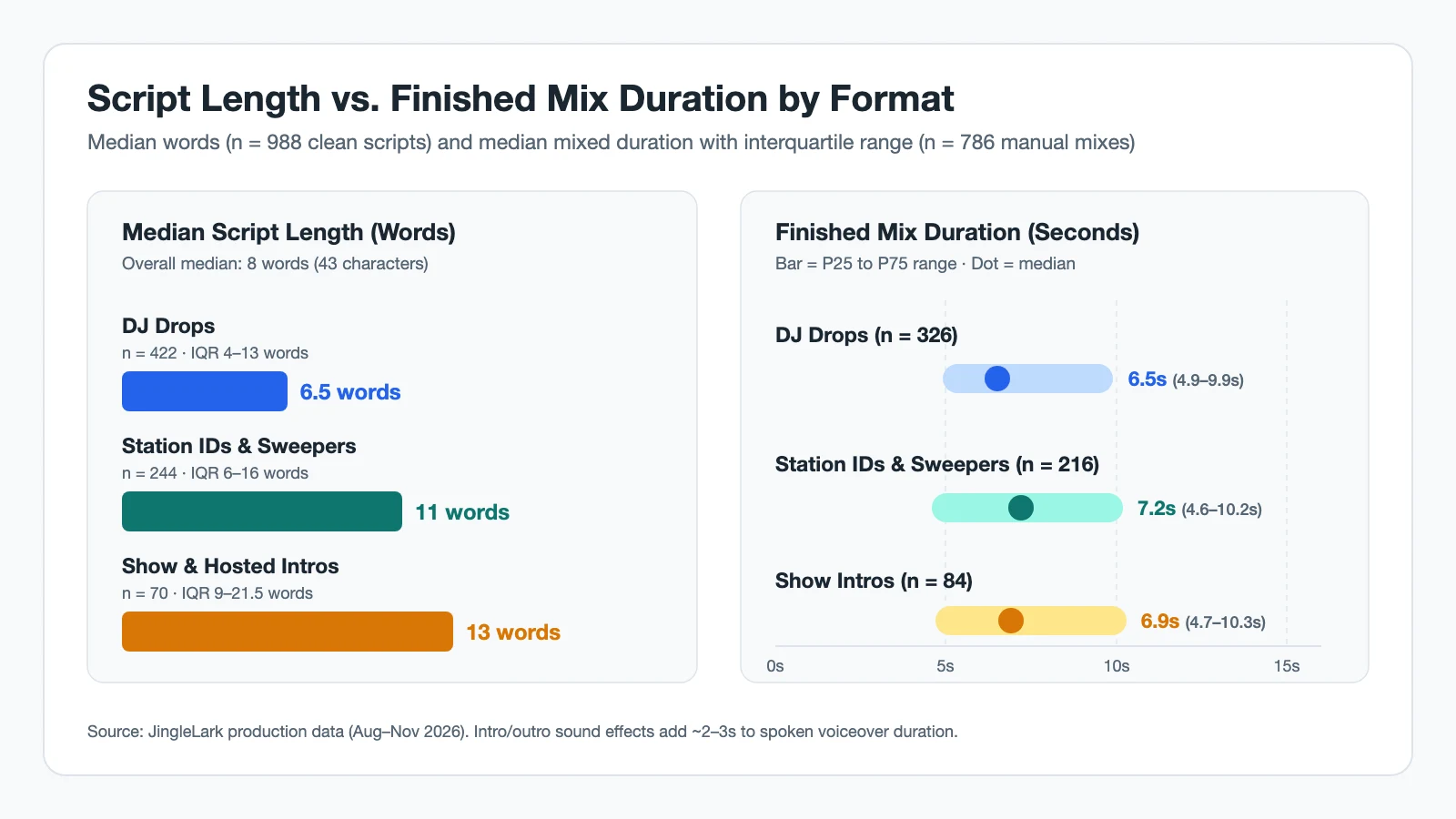
The table below separates the four main spoken formats broadcasters produce, pairing our measured imaging data with standard commercial spot slots:
| Format | Median script | Script IQR (P25–P75) | Median mixed cut | Mix IQR (P25–P75) |
|---|---|---|---|---|
| DJ drops (n = 422 scripts / 326 mixes) | 6.5 words (32 chars) | 4–13 words | 6.5 s | 4.9–9.9 s |
| Station IDs & sweepers (n = 244 / 216) | 11 words (61.5 chars) | 6–16 words | 7.2 s | 4.6–10.2 s |
| Show & hosted intros (n = 70 / 84) | 13 words | 9–21.5 words | 6.9 s | 4.7–10.3 s |
| Commercial sponsor spots (ad break) | 30–40 (15 s) / 70–80 (30 s) / 120–150 (60 s) | n/a | 15 s, 30 s or 60 s | Standard ad-break slots |
Three patterns stand out when you put these formats side by side:
- DJ drops stay name-first. Half of DJ drop scripts sit between 4 and 13 words, usually just the DJ name plus a short energy line ("in the mix", "on the decks"). Longer lines clash with a track's vocal intro.
- Station IDs need room for a slogan or legal wording. Licensed US broadcasters must air call letters immediately followed by the community of license under FCC rule 47 CFR §73.1201. That legal wording alone takes 3 to 5 seconds, leaving room for a short slogan before hitting the 7- to 10-second sweet spot. See our station identification rules and examples for compliant wording.
- Sponsor reads belong in a separate bucket. Once a script crosses 25 words to explain an offer, hours or address, it is no longer imaging. Treat it as a 15- or 30-second spot and use dedicated radio ad script templates rather than stretching a station sweeper.
How do stations actually mix intros, music beds and outros?
More than half of real radio cuts use all three production layers (an intro effect, a music bed and an outro), while roughly one in seven skips the bed altogether to build a dry sweeper. Across 808 manually built mixes (excluding automatic first mixes), track-slot choices break down like this:
| Track combination | Manual mixes (n = 808) | Share | Best use on air |
|---|---|---|---|
| Intro + bed + outro | 464 | 57.4% | Top-of-hour IDs, show opens, stopset bumpers |
| Intro + outro (no bed) | 117 | 14.5% | Dry sweepers fired over a song intro |
| Voice only (with vocal processing) | 61 | 7.5% | Tight DJ tags and talk-up liners |
| Intro only | 55 | 6.8% | Quick stings before a cold-start track |
| Intro + bed | 43 | 5.3% | Music-led liners that crossfade into the next song |
| Bed + outro / bed only / outro only | 68 | 8.4% | Custom transitions and soft show outros |
To see which sound styles stations actually prefer, we separated out JingleLark's default Starter Kit tracks and counted only mixes where users actively picked a different sound.
Among the 445 custom intro picks, risers lead at 31.9% (142), followed by vinyl scratches at 11.2% (50) and digital glitches at 9.0% (40). Risers work across almost any genre because they build into the first spoken syllable without clashing with the song's key.
Among the 420 custom music bed picks, hip-hop (18.8%, 79), lo-fi (17.9%, 75) and synthwave (17.4%, 73) form a near three-way tie, ahead of seasonal beds (14.0%), corporate (11.9%), rock (11.7%) and ambient (8.3%).
Among the 367 custom outro picks, fades (echo-out, tape-stop and smooth fades) take 40.1% (147), nearly double hard impacts at 21.8% (80). A clean fade lets playout software overlap the tail into the next song without a harsh cut.
Stations also iterate on the mix before locking a cut: among voiceovers that users mixed manually, the average was 1.9 mixes per voiceover (P90: 4 mixes, max: 15). Keeping mixing free encourages testing a dry sweeper against a full-bed cut at proper broadcast loudness, such as the EBU R 128 −23.0 LUFS standard used by broadcast playout systems.
What writing and pacing habits show up in real scripts?
Most broadcasters leave speech speed untouched and rely on short phrasing rather than heavy punctuation or voice tricks. Across the 988 clean scripts, five practical habits stood out:
- Stick to one idea and one station-name order. Overstuffed sweepers that combine music format, request number and show schedule push radio jingle length past 15 seconds and blur recall. Keep one message per cut and say your station name the exact same way on every ID.
- Keep normal reading speed. 80.6% of scripts (796 of 988) stay at 1.0× speed. Faster reads (>1.0×: 9.6%) and slower reads (<1.0×: 9.8%) split evenly, because speeding up an announcer rarely rescues an overcrowded script.
- Punctuation signals energy, not length. 30.8% of scripts (304) include an exclamation mark and 11.2% (111) are written in ALL CAPS. Use one exclamation point for punch; stacking three rarely improves delivery.
- Drop web addresses and social handles from short IDs. Only 0.4% of scripts (4 of 988) include a URL or
@handle. Listeners rarely type a link they heard in a 6-second sweeper; save addresses for 15- or 30-second promos. - Never put stage directions inside brackets. Roughly 0.9% of clean scripts still contained bracketed notes like
[echo]or[air horn], which text-to-speech engines try to read aloud unless stripped. Pick effects in the mixer instead of typing them into the script. - Use pronunciation fixes and cloned voices for local names. 5.5% of scripts (54) used a cloned host voice, and 3.3% (33, after the feature launched in late October 2026) used a pronunciation override for local towns, call signs or DJ names.
Before finalizing a cut's length, check where it sits on your hour. As the University of Delaware's radio programming notes point out, stations plan fixed imaging points around music sets and quarter-hours. Our 60-minute radio hot clock template maps where 5- to 10-second IDs, sweepers and liners fit without dragging the hour.
How this study was produced (methodology and limits)
The radio jingle length dataset in this study comes from a read-only aggregate query of JingleLark production records created between August 29, 2026 and November 23, 2026 (UTC).
For scripts, we started with 1,072 completed non-test voiceover records, removed internal and admin accounts, and filtered out 84 verbatim sample or pre-filled template scripts matching our built-in example station names and template lines. That left 988 clean scripts from 854 unique users.
For mixes, we started with 1,336 non-test mix records, removed 528 automatic first mixes generated without user clicks, and measured 786 manually built mixes linked to clean scripts (808 total manual mixes across 379 users for track-slot shares). All mix durations are real ffmpeg-measured audio lengths. For sound-group rankings, we excluded the three default Starter Kit tracks so defaults did not inflate riser, bed or swoosh totals.
Every figure is aggregated; no station names, DJ names or raw scripts were inspected or published. This dataset reflects small internet, community and hospital radio stations and DJs making spoken imaging, not commercial radio networks commissioning sung jingle packages. Read more about our work on the About JingleLark page.
Frequently asked questions
How long should a radio commercial jingle be compared to a station ID?
A commercial radio ad spot runs 15, 30 or 60 seconds because it is sold in fixed stopset inventory and has to carry a sponsor message and call to action. A radio station ID or sweeper sits between songs and runs 5 to 10 seconds (6.7 seconds median in our study).
Does the FCC set a minimum or maximum length for a legal station ID?
No. Under 47 CFR §73.1201, US broadcast stations must air their call letters immediately followed by their community of license near the top of each hour, with no mandated second count. Most legal IDs take 4 to 8 seconds spoken cleanly.
How many radio jingles should you play in a one-hour show?
Most small music stations air 4 to 6 imaging cuts per hour: a top-of-hour station ID at :00, a half-hour ID around :30, two sweepers between music sets, and a liner or show tag coming out of breaks. Keeping each cut under 10 seconds keeps total imaging under one minute per hour.
Can JingleLark lock a jingle to an exact 5- or 10-second duration?
No. JingleLark does not offer fixed 5-, 10-, 15- or 30-second duration locks, because runtime follows your script length (roughly 13 characters per second for English voices) plus the intro and outro you pick. Trim a few words or swap to a shorter intro or outro with free unlimited remixing to hit your target slot.
Table of Contents
Author

Categories
Tags
More Posts
Radio Show Ideas: 14 Formats for Small Stations
14 radio show ideas for internet, community, hospital and student stations, the rule to check before each one airs, and how to lay an idea out as one hour.
Radio Hot Clock: A 60-Minute Template for Small Stations
A minute-by-minute hot clock for small and internet radio stations, the reason behind each slot, and how to set it up in PlayIt Live, mAirList, AzuraCast, Live365 or RadioDJ.
Radio Formats: 9 Types, Rotation Clocks & Station Imaging
Learn how 9 core radio formats work, see 2025 Nielsen listening shares, and match your station's rotation clock and voiced imaging to your format.